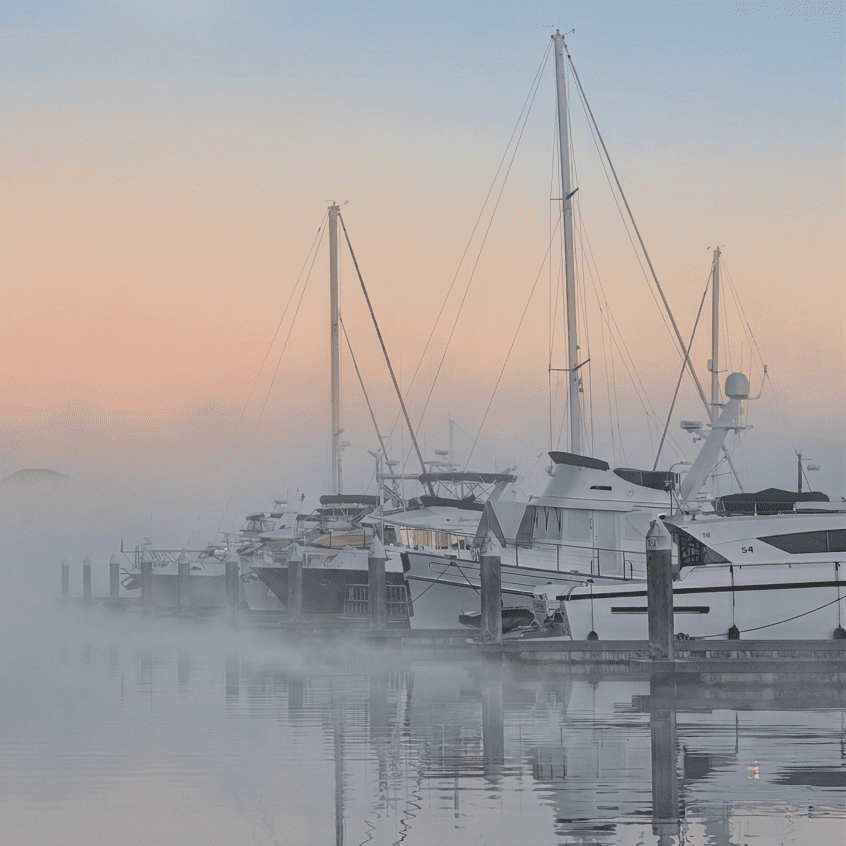
As Fall settles over the Pacific Northwest, the days get shorter and the temperatures drop. The smoky haze on the horizon from wildfires in British Columbia disappears, along with the hot days when shorts, T-shirts and bare feet are the uniform of preference. In their place “layers” become the appropriate clothing choice, and we get a chill in the air, a brisk wind that ruffles the water, and bright white clouds racing across an impossibly blue sky. Fall on the boat is spectacular!

Often though, Fall days begin with fog. Most of the time it burns off long before noon, but on rare occasions it lingers all day. We found ourselves in that situation not too long ago while crossing the Strait of Juan de Fuca – a four-hour trip in our boat. It’s “big water”, busy with cargo ships, tankers, ferries, cruise ships, fishing boats and pleasure craft. On that day, the fog was so thick we could barely see past the bow of the boat. How do boats navigate in such conditions without hitting anyone or being hit? Very carefully!
Our electronic navigation system uses GPS to plot our location on the charts, so we can see where we are even when we can’t tell by looking outside. Our radar sweeps the area, pinging off objects and reflecting back to us their location and distance – but radar can’t differentiate between waves, rocks, and vessels, so small boats can get lost in the clutter. We also have the AIS (the maritime Automatic Identification System) turned on that displays nearby vessels on our charts. The problem is that not every boat has AIS. A vessel without AIS is invisible to us electronically. And they can’t see us, either.
All of this matters when navigating in thick fog. As we made our way across the Strait, Scott was blasting the horn for five seconds every two minutes. We were concerned about smaller personal vessels that rarely carry AIS and are hard to see on radar. Because we couldn’t be sure we’d detect them electronically or see them in the fog, we relied on the same basic method sailors have used for hundreds of years; sound signals – bells traditionally, or in our case, a horn. A few horns answered through the fog, and we kept our distance. In the end, we had no close calls, but crossing the Strait of Juan de Fuca while flying blind takes a bit of trust!
That crossing is a vivid picture of everyday life for me. We do all we can to avoid wrong decisions and keep from setting ourselves on a collision course with disaster, yet there are times the fog closes in anyway. The horizon disappears, the way forward is veiled, and we have no idea how to proceed. In those moments, we are forced to admit to ourselves that our sense of control is an illusion. That feeling is difficult for most of us, but it teaches us we can’t manage every outcome; that we must set aside fear and place our faith in something beyond ourselves.

We have gone through this process many times in our life, and I can say that, without fail, Jesus has led us through. When the fog descends, we’re never lost; He always shows us the way.
For we live by faith, not by sight. 2 Corinthians 5:7
Leave a Reply